pig
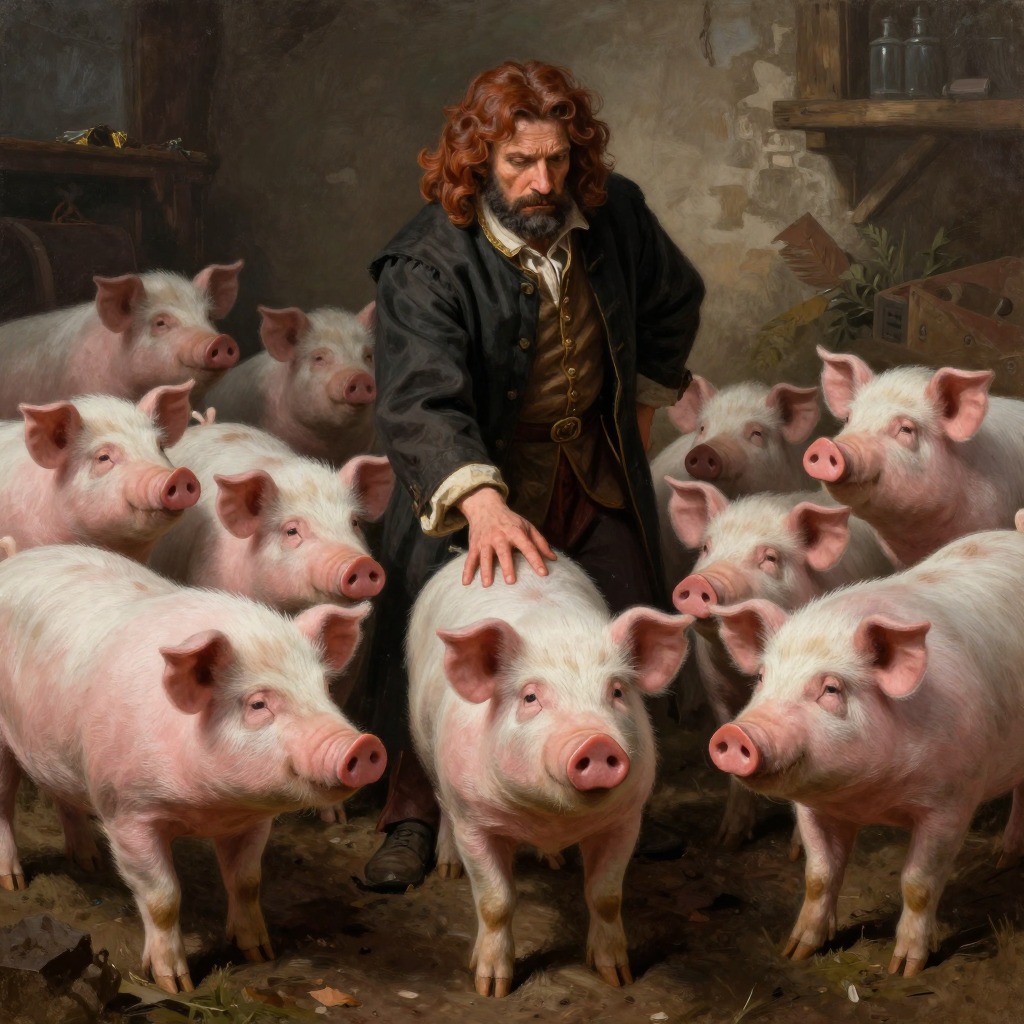
The pigs are the ruling class of Animal Farm, who, beginning as the intellectual leaders of the Rebellion, gradually transform into a tyrannical elite indistinguishable from the human beings they overthrew.
Identity and Rise to Leadership
From the earliest days of the Rebellion, the pigs were recognized as the cleverest animals on the farm, and it fell naturally to them to teach and organize the others. Pre-eminent among them were two young boars named Snowball and Napoleon, whom Mr. Jones had been breeding up for sale. Napoleon was a large, fierce-looking Berkshire boar, not much of a talker but with a reputation for getting his own way. Snowball was more vivacious, quicker in speech and more inventive, though not considered to have the same depth of character. The best known among the other male pigs was a small fat pig named Squealer, with very round cheeks, twinkling eyes, nimble movements, and a shrill voice; he was a brilliant talker, and the others said of him that he could turn black into white. These three elaborated old Major's teachings into a complete system of thought called Animalism, holding secret meetings in the barn several nights a week to expound its principles. The pigs did not actually work in the fields during the first harvest but directed and supervised the others, it being considered natural with their superior knowledge that they should assume the leadership.
Privilege and the Consolidation of Power
Almost immediately after the Rebellion, the pigs began to claim privileges for themselves. The milk from the cows disappeared, and it was soon discovered that it was mixed every day into the pigs' mash. When the early apples ripened, an order went forth that all the windfalls were to be collected and brought to the harness-room for the use of the pigs. Squealer was sent to explain that milk and apples contained substances absolutely necessary to the well-being of a pig, as they were brainworkers on whom the whole management of the farm depended. The pigs also taught themselves to read and write from an old spelling book, and Snowball inscribed the Seven Commandments on the wall of the big barn. As the pigs' power grew, they moved into the farmhouse and took up residence there, sleeping in the beds. When Clover questioned this, Muriel read the Fourth Commandment, which now said, "No animal shall sleep in a bed with sheets." Squealer explained that the rule was against sheets, which were a human invention, and that the pigs had removed them. The pigs also began to get up an hour later in the mornings than the other animals. Napoleon, after expelling Snowball with the help of nine enormous dogs he had raised in secret, abolished the Sunday-morning Meetings and announced that all questions relating to the working of the farm would be settled by a special committee of pigs, presided over by himself. The pigs' diet became increasingly luxurious: every pig received a ration of a pint of beer daily, with half a gallon for Napoleon himself, served in the Crown Derby soup tureen. Barley was reserved for the pigs alone.
Ideology and Propaganda
The pigs were the primary producers and enforcers of the farm's ideology. Squealer made excellent speeches on the joy of service and the dignity of labour, and he was constantly sent round the farm to explain new arrangements. He would talk with the tears rolling down his cheeks of Napoleon's wisdom, the goodness of his heart, and the deep love he bore to all animals everywhere. The pigs invented for Napoleon such titles as Father of All Animals, Terror of Mankind, Protector of the Sheep-fold, and Ducklings' Friend. Minimus, a pig with a gift for composing songs and poems, wrote a poem entitled "Comrade Napoleon," which Napoleon approved and caused to be inscribed on the wall of the big barn, surmounted by a portrait of Napoleon in profile executed by Squealer in white paint. The pigs also organized weekly Spontaneous Demonstrations, with the pigs leading the procession, followed by the horses, cows, sheep, and poultry, while the dogs flanked the march. The sheep, under the pigs' tutelage, were taught to bleat "Four legs good, two legs bad" at crucial moments to drown out dissent. The pigs eventually abolished the singing of 'Beasts of England', replacing it with a song composed by Minimus that began, "Animal Farm, Animal Farm, Never through me shalt thou come to harm!"
Violence and the Purge
The pigs' rule was maintained through systematic violence. After Snowball's expulsion, Napoleon decreed a full investigation into his activities, with the dogs sniffing for traces of his footsteps. The pigs orchestrated a series of executions, forcing animals to confess to crimes such as being in league with Snowball. The four pigs who had protested when Napoleon abolished the Sunday Meetings were among the first to be dragged forward by the dogs and forced to confess that they had been secretly in touch with Snowball, had collaborated with him in destroying the windmill, and had agreed to hand over Animal Farm to Mr. Frederick. After their confessions, the dogs tore their throats out. The pigs also decreed that any animal giving so much as a grain of corn to a hen during the hens' rebellion should be punished by death. The pigs themselves, however, were not subject to the same laws: when Napoleon was discovered to have drunk whisky, he pronounced a solemn decree that the drinking of alcohol was to be punished by death, but he himself continued to drink, and the pigs acquired money to buy themselves another case of whisky.
Final Transformation and Thematic Significance
By the end of the novel, the pigs had completely abandoned the principles of Animalism. They began to walk on their hind legs, with Squealer strolling across the yard awkwardly but with perfect balance, followed by a long file of pigs all walking on their hind legs. Napoleon himself emerged majestically upright, carrying a whip in his trotter. The pigs took to wearing Mr. Jones's clothes, with Napoleon appearing in a black coat, ratcatcher breeches, and leather leggings, while his favourite sow appeared in the watered silk dress Mrs. Jones had been used to wearing on Sundays. The pigs bought themselves a wireless set, arranged to install a telephone, and took out subscriptions to human newspapers. The Seven Commandments were reduced to a single principle: "ALL ANIMALS ARE EQUAL BUT SOME ANIMALS ARE MORE EQUAL THAN OTHERS." The name of the farm was changed back to Manor Farm, the green flag was altered to a plain green flag with the hoof and horn removed, and the custom of addressing one another as "Comrade" was suppressed. At a dinner party with neighbouring farmers, Napoleon and Mr. Pilkington played cards together, and the creatures outside, looking from pig to man and from man to pig, found it impossible to say which was which. The pigs, who had begun as the intellectual leaders of a rebellion against human tyranny, had become indistinguishable from the humans they had overthrown, embodying the novel's central warning about the corrupting nature of power.